
Field Notes from the Volunteer Science Program
By Jordan Gray, External Relations Manager, Turtle Survival Alliance
Long before I saw him, I heard him.
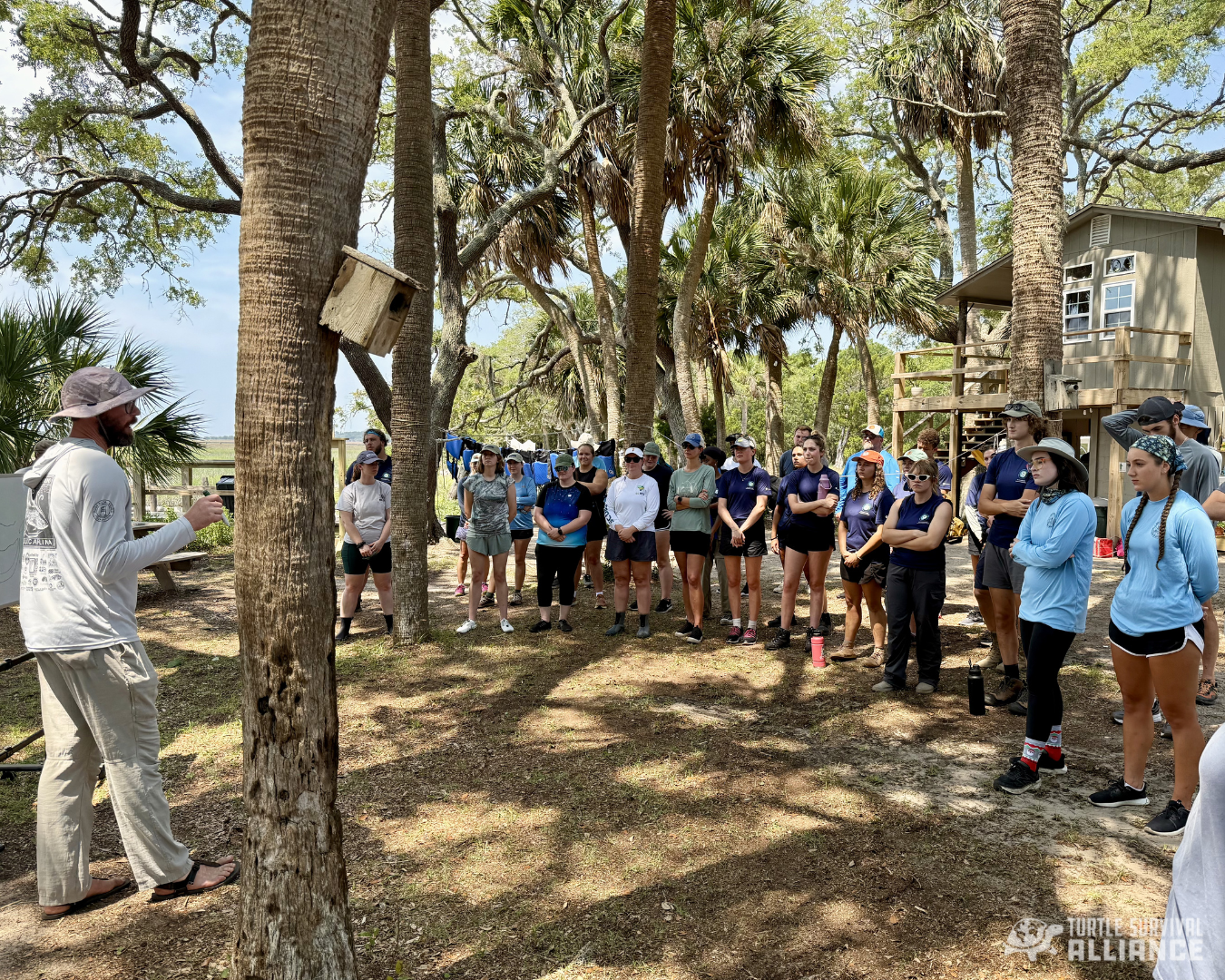
Beneath the sprawling live oaks of St. Helena Island, Chris Kehrer’s unmistakable voice carried across the gathering of volunteers.
Coming north from my home in Georgia, the drive had been a winding journey through South Carolina’s Lowcountry, with what felt like an endless series of turns before finally arriving at Coastal Expeditions’ St. Helena Island outpost. If you weren’t paying attention, you could easily drive right past it.
Chris, Science Program Manager for the Port Royal Sound Foundation, didn’t need a microphone. His voice was enough.
It wasn’t a lecture about birds or dolphins, the usual stars of South Carolina’s coast. Instead, he was introducing volunteers to a technique unfamiliar to most of the crowd, particularly those who had never encountered a Diamondback Terrapin (Malaclemys terrapin).
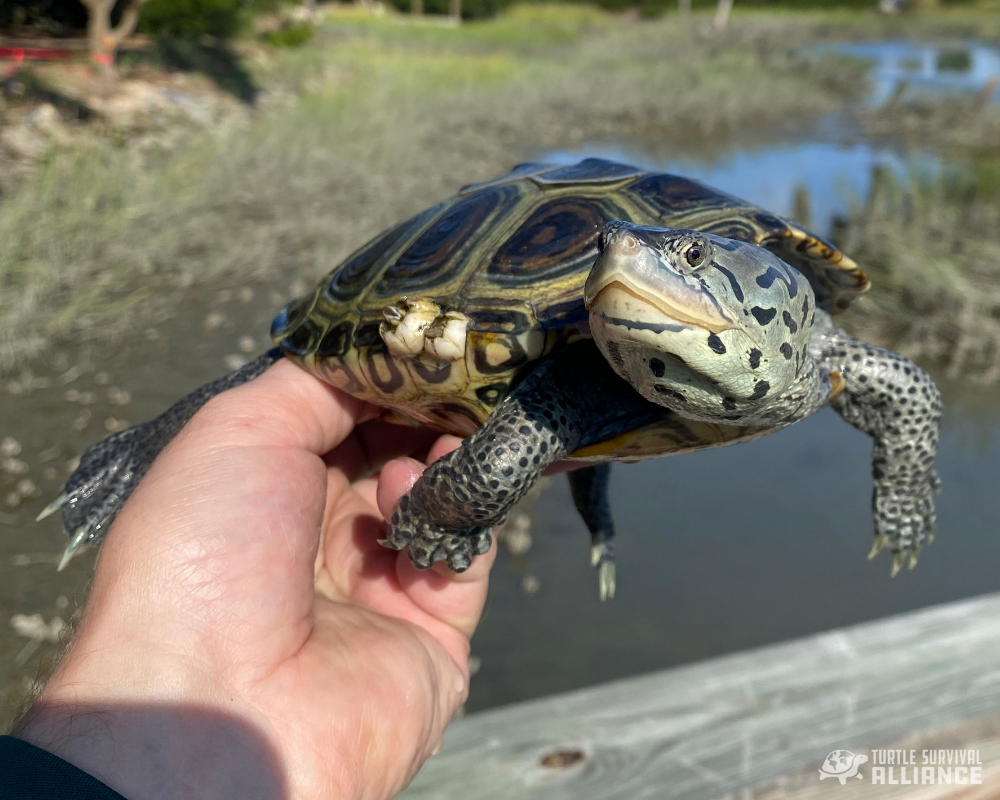
The Diamondback Terrapin is arguably the East Coast’s most iconic marsh reptile. They’re unique among the world’s turtles, the only species that spend their entire life in and around brackish water.
With a dry erase board to his left and a hand-drawn schematic of the tidal salt creek behind him, complete with a Diamondback Terrapin that looked more like an abstract art exhibit than a turtle, Chris ran through what the nearly 50 volunteers could expect once they plunged into the marsh, reviewed important safety considerations, and explained the mechanics of terrapin seining.
Terrapin what?
In salt marshes along the Atlantic coast, biologists ranging from seasoned academics and state wildlife professionals to volunteer scientists use large seine nets to capture Diamondback Terrapins for research. In studies like ours, these nets can span up to forty feet and are pulled through the water by operators on either end, with additional volunteers helping to guide and stabilize the net through the marsh. To do this, we often form human chains, linking arms or holding hands to help move the seine poles forward through mud and current. Imagine a line of biologists moving in sync… or at least in some recognizable semblance of it… and you get the picture.
Chris’s introduction was only the beginning. Jake Zadik of Lowcountry Ecological LLC and Ryan Hanscom of the University of South Carolina Beaufort, who along with Chris have spearheaded this study, followed with an overview of the study’s scientific goals before I introduced volunteers to the natural history and ecology of the Diamondback Terrapin, providing the context behind everything they were about to experience in the marsh.
This survey is part of Turtle Survival Alliance (TSA)’s growing Volunteer Science Program, which brings together researchers, conservation organizations, zoos, colleges and universities, students, and community volunteers to better understand wild turtle populations while connecting people directly with conservation in the field.
Turtle Survival Alliance is a global conservation organization working across more than 30 countries to protect and restore wild populations of turtles and tortoises. Through a broad network of field programs and projects, assurance colonies, and conservation partnerships, TSA supports both in situ research and hands-on conservation action, including numerous Volunteer Science Program study sites across the United States. These include the South Carolina Lowcountry.
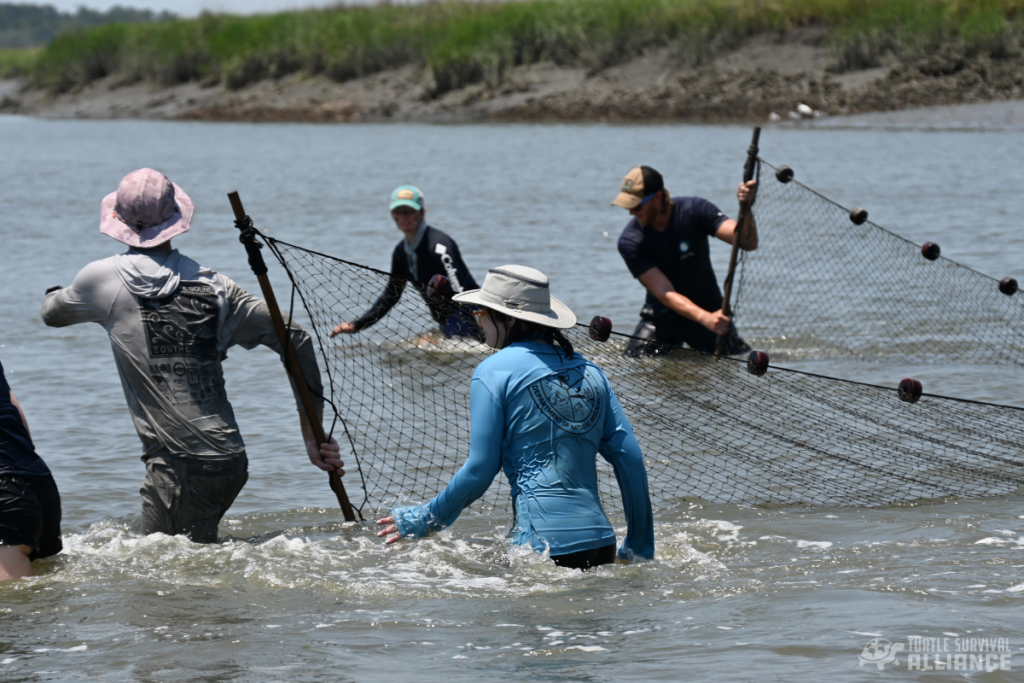
On this brutally hot June day, 50 volunteers gathered for what we affectionately refer to as “The Big Sample.” Three times each year, over the course of two or three consecutive days, the team behind this long-term project surveys six tidal creeks in search of Diamondback Terrapins.
Catching them isn’t the goal, understanding their population status is. Every turtle measured, cataloged, and released adds another piece to the puzzle, helping scientists track populations and guide future conservation efforts. And for the Diamondback Terrapin, this is important.
Since the United States declared its independence from Great Britain 250 years ago, and well before that, Diamondback Terrapins have been part of the salt marsh ecosystem and a food source for people living along the coast.
In the late 1800s, terrapin meat became highly sought after in American cuisine, particularly in urban restaurants, and intense harvest pressure led to steep population declines across much of their range, including South Carolina and the Beaufort area. In the century since that market demand subsided, terrapin populations have recovered in some areas, though not uniformly across their distribution.
Today, they face a new suite of threats, including drowning in crab pots, coastal habitat loss, road mortality, and increased predator populations. The cumulative impact of these pressures makes population monitoring increasingly important. Long-term studies like this help scientists understand whether populations are stable, increasing, or declining—and guide conservation decisions before it’s too late.
This creek is broad, deep in many places, and perfectly suited for involving volunteers from all walks of life. This is exactly the kind of project where Volunteer Science shines. Undergraduate students, wildlife professionals, and first-time citizen scientists alike can all play an important role, provided they don’t mind getting soaked in saltwater and caked in marsh mud. But if they are here, I imagine they are already enthusiastic about the idea.
For this survey, we were fortunate to be joined by staff from Riverbanks Zoo & Garden in Columbia, South Carolina, a robust contingent of AmeriCorps members, and numerous students from the University of South Carolina Beaufort. All had been briefed on what to expect.
Then reality hit.
The first surprise wasn’t unpleasant. The moment you step into a brackish tidal creek, you become part of it. Despite the oppressive June heat, the late-spring water is warm, yet still refreshingly cool enough to take the edge off the sweltering sun. Tiny shrimp brush against your legs, occasionally clinging to clothes or bare skin before darting away. Along the exposed mud banks, millions of fiddler crabs stand at attention, the males enthusiastically waving their oversized white claws as if welcoming us to their world. Marsh Wrens, a tiny bird with a big voice, make their territory known.
Of course, the marsh has a way of reminding you that every welcome comes with a price.
For those unfamiliar with venturing through turbid tidal creeks on foot, the marsh quickly reminds you that it demands respect. Oyster mounds and the occasional sunken relic of man’s presence appear without warning beneath the murky water. The sudden splash of a startled stingray is enough to stop you in your tracks.
But it’s the mud. Definitely the mud.
The famed pluff mud of the Carolinas and Georgia is rich in decaying organic matter, shaped by one of the greatest tidal ranges on the Atlantic coast. Thick, black, and remarkably adhesive, it seems determined to keep every shoe it encounters. Each step becomes a negotiation between forward progress and leaving your footwear behind.
It’s worth it.
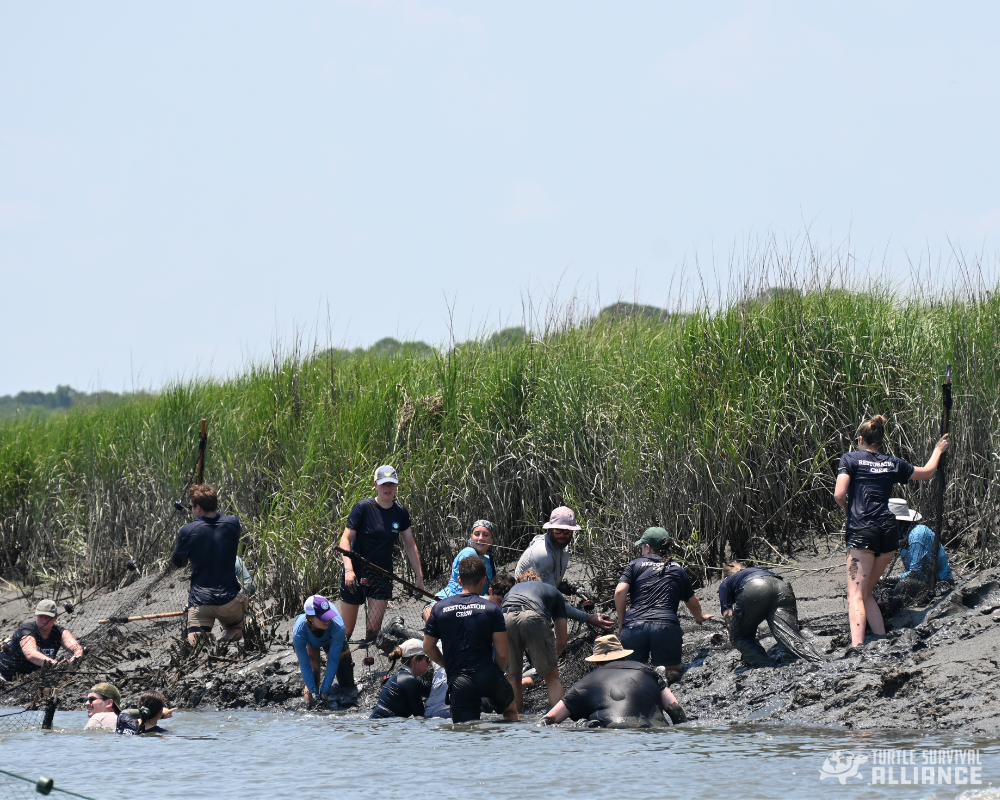
Chris, Jake, Ryan, and I became the day’s field coordinators, moving between teams, directing volunteers where extra hands were needed, and guiding each group toward the banks where they would haul in their hopeful catch.
For anyone who has ever fished, dip-netted, or woken up on Christmas morning wondering what might be waiting under the tree, this is the moment everything builds toward. It has a way of making every volunteer feel like a kid again.
This stretch of river is roughly 500 meters in length, about five city blocks, and represents a substantial effort to properly sample. And yet, it is just a tiny blip on the map of South Carolina’s vast salt marsh ecosystem.
South Carolina contains roughly one-third of all salt marsh habitat along the U.S. Atlantic Coast, creating an immense expanse of suitable habitat for Diamondback Terrapins. That same scale presents a challenge at representative sites like this one essential for understanding how terrapin populations are changing over time.
Now in the study’s third year, we’ve captured, cataloged, and released nearly 100 terrapins. Thanks to the number of participants who take part in “The Big Sample,” we’re able to deploy five seine nets simultaneously: three moving against the outgoing tide at one end of the creek and two moving with the tide at the other. Essentially, we create a giant seine net sandwich, hoping to capture any terrapins using that stretch of creek at that moment.
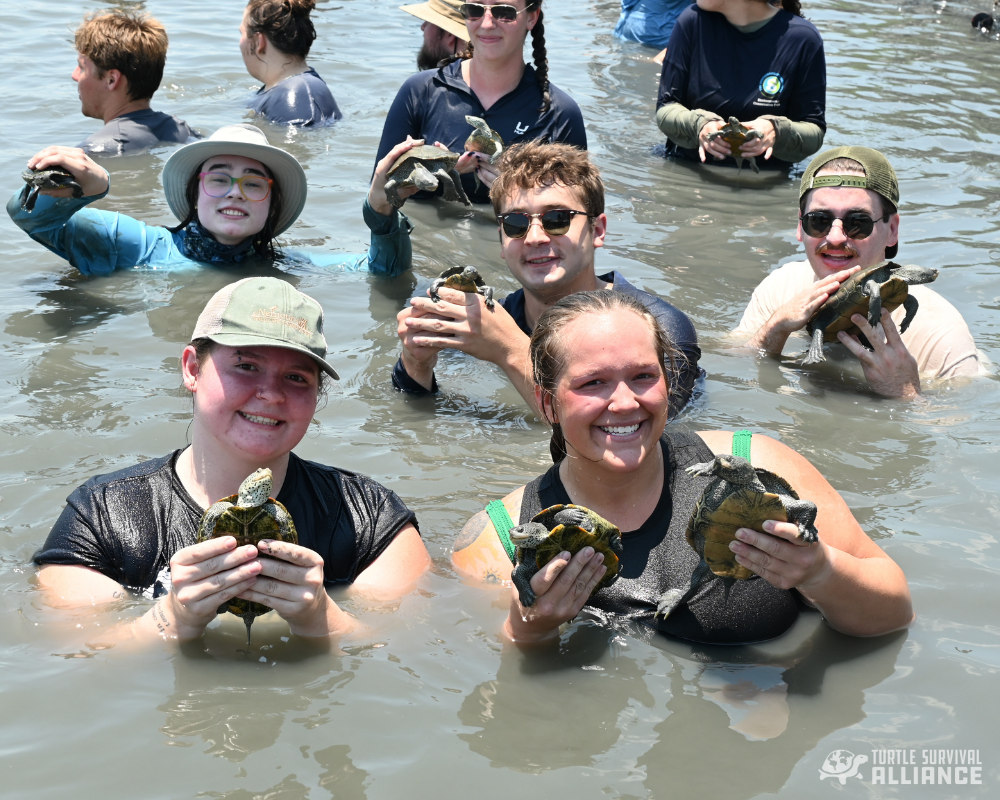
The sandwich proved especially successful that day, yielding 37 terrapins: 16 females and 21 males. Thirteen had been captured previously, including one female and 12 males. As each net reached shore, volunteers called out the number of terrapins inside: “Three!” “Five!” and, in one memorable haul, “Thirteen!” Of course, not every net was productive. Calls of “Nothing!” were just as common.
For many volunteers, this was their first opportunity to contribute directly to wildlife conservation. Through Turtle Survival Alliance’s Volunteer Science Program, participants don’t just observe science, they become part of it. Every survey strengthens our understanding of wild turtle populations while creating new ambassadors for conservation.
Of course, terrapins aren’t the only creatures swept up in the seine. Southern Stingrays, Blue Crabs, Spot, and Southern Flounder are common bycatch. Every animal is handled with the same care as the terrapins and quickly returned to the creek.
It’s always exciting to see “who” is using this section of the creek on any given day. Because it’s an open system, terrapins can move in and out as they please. Some may remain in this stretch year-round, while others visit only occasionally as part of a larger home range.
That’s the beauty of long-term monitoring. Each year adds another layer of understanding, not only about individual terrapins, but about the health of the population as a whole. Although the project is only in its third year, we’re continuing to document new individuals while beginning to understand which turtles appear year after year. As the dataset grows, so will our ability to identify meaningful population trends.
Those findings will ultimately guide conservation action. That could mean installing fencing along nearby roadways to protect nesting females, advocating for Bycatch Reduction Devices (BRDs) on crab pots, or creating safer nesting habitat.
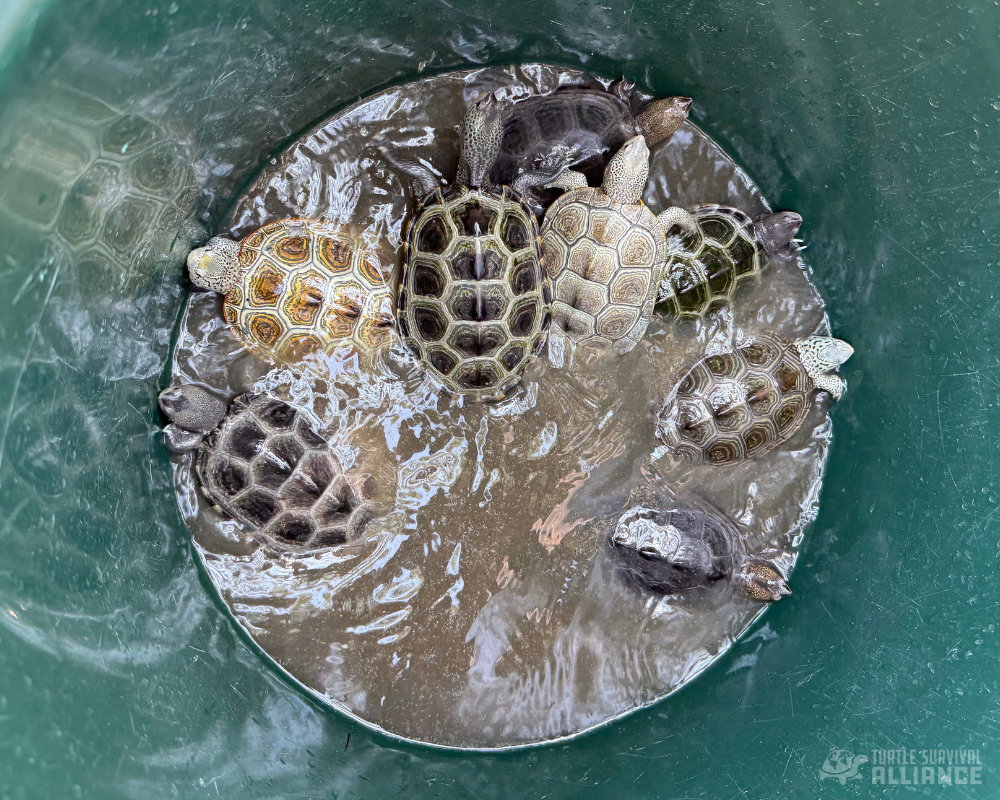
In South Carolina, the tide turns quickly from outgoing to incoming. Because this tidal creek is both broad and relatively deep, the changing tide signals that it’s time to wrap things up. Otherwise, every participant would end up swimming back to shore.
Two hours of grueling seining beneath an intense, briny sun is enough to wear anyone out. Besides, one of our goals is to make the experience enjoyable for everyone. For those who have had enough, motorboats are always standing by to shuttle weary volunteers back to shore.
Despite the mud, heat, and occasional scrapes from oyster shells, spirits remained high. Hunter Balog, Conservation Project Manager at Riverbanks Zoo & Garden, summed up the experience afterward: “Thanks for having us! We had a blast, oyster shell cuts and all… We’ve got lots of people excited for the September sampling.”
For many participants, that enthusiasm is exactly the point. Volunteer Science isn’t simply about collecting data, it’s about building a community of people who care enough to become lifelong advocates for turtle conservation. Every person who leaves the marsh with muddy shoes also leaves with a deeper connection to the species they’re helping protect.
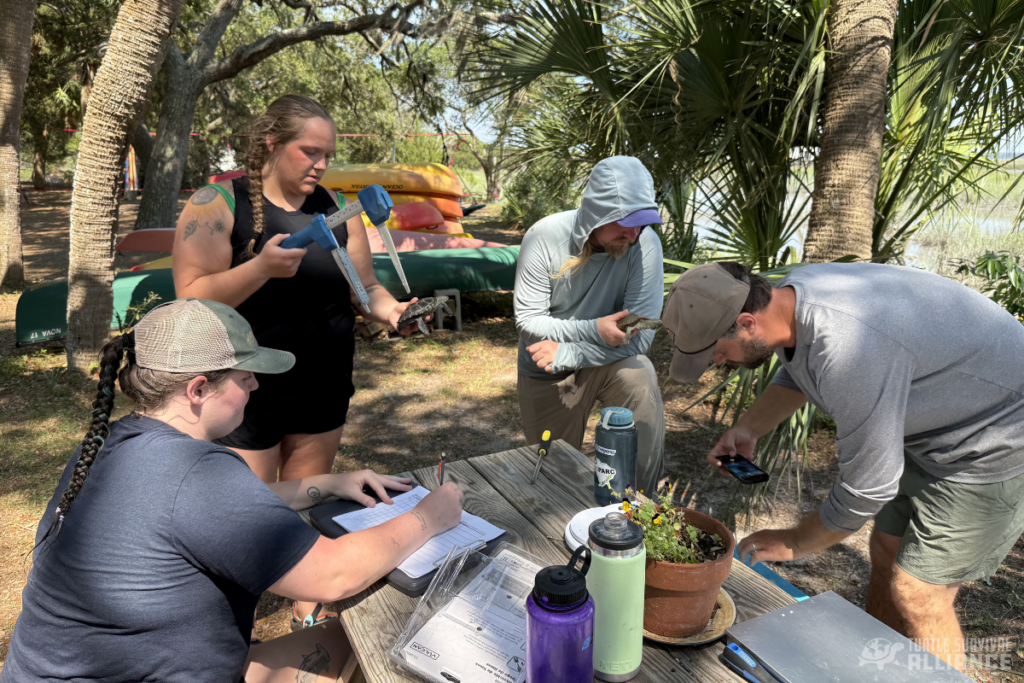
Back at Coastal Expeditions, the work is far from over. One by one, the terrapins are carefully processed as volunteers gather around to lend a hand and learn from the research team. Measurements are taken, each turtle is weighed, checked for an existing identification code or assigned a new one if it’s a first-time capture, and its overall condition is documented before being returned to the creek.
It’s a rare opportunity to see conservation science unfold firsthand, ask questions, and gain a deeper appreciation for the biology and ecology of these remarkable turtles. For many volunteers, it’s also a chance to spend a few quiet moments with the animals that brought them to the marsh before they’re released back into the wild.
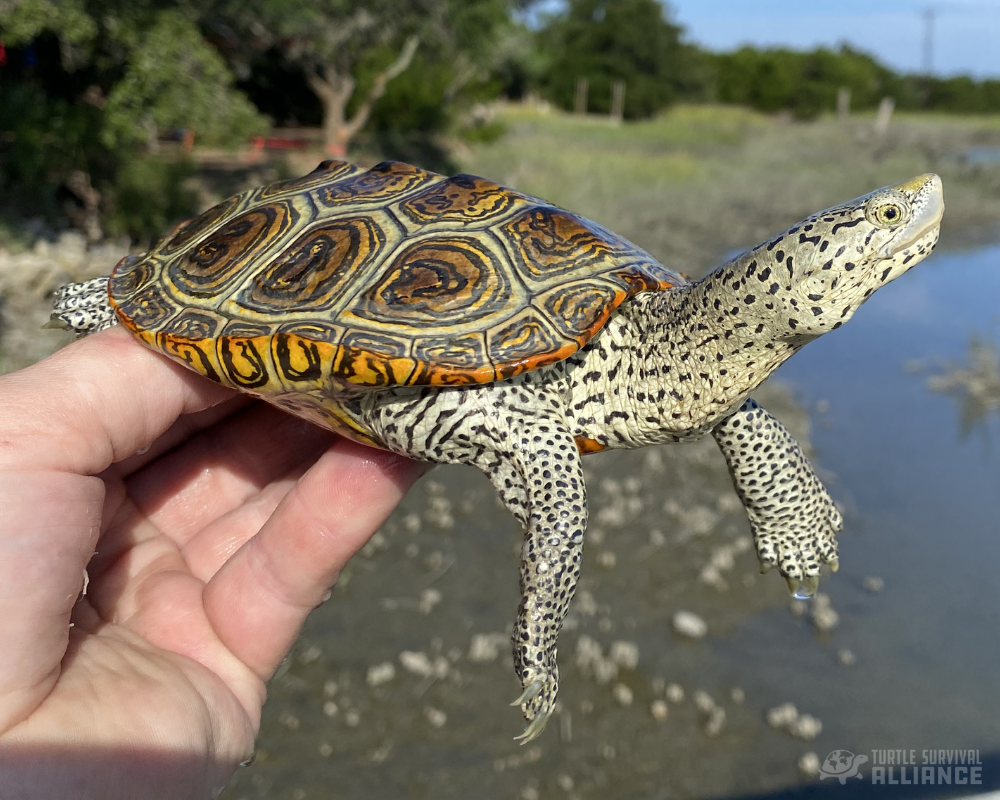
Among the previously captured turtles was a stunning adult male I recognized immediately. Diamondback Terrapins come in an astonishing variety of colors and patterns, yet his golden shell, brownish-black concentric markings, silvery skin speckled with black, and yellowish-green snout make him unmistakable. On the data sheet, he’s simply “KP.” To me, he’s becoming something more. If we catch him again, I think he’ll finally earn a proper name. It’s impossible not to root for an animal you’ve come to recognize. That’s one of the unexpected gifts of long-term conservation work.
As I pointed my 4Runner back toward Georgia, I couldn’t help but reflect on what had made the day so rewarding. It wasn’t just the terrapins we had captured, measured, and released. It was the shared sense of purpose among dozens of volunteers who had come together to contribute to meaningful conservation science, and my hope that they would take that experience home and share it with others.
This project reflects what Turtle Survival Alliance’s Volunteer Science Program is all about: bringing people together to learn about and protect turtles while inspiring others to become part of the solution. Every survey expands our understanding of wild populations, strengthens conservation partnerships, and creates new ambassadors for turtles and the habitats they depend on.
Come September, we’ll once again gather beneath the live oaks, listen to Chris’s unmistakable voice carry across the crowd, and jump into the tidal creek, pluff mud and all, for another opportunity to find, document, and appreciate these true diamonds of the marsh. I’ll be looking forward to seeing what, and who, the next tide brings.
###
Would you like to experience turtle conservation firsthand? Join us for a future Diamondback Terrapin survey or learn more about Turtle Survival Alliance’s Volunteer Science Program, email me at jgray@turtlesurvival.org. We’d love to welcome you to the marsh.