
By Elena Duran, Communications Manager, Turtle Survival Alliance
Say you’re given a box of crayons and asked to draw a turtle. You’d probably go for green, draw four stubby legs, a round shell, maybe in a slightly darker green, and a long neck sticking out of its shell. If I had to draw a turtle, I’d grab the gray, black, and yellow crayons. I’d start with a golden shell, decorated in a diamond-shaped pattern. The legs would be light gray, smattered with black spots, and the legs would end in webbed feet. Its head is my favorite part: a slightly pointed, grayish-white face, with a prominent mustache.
This may sound like the doodle of a child’s imagination, but it’s actually an apt description of a real species: the Diamondback Terrapin (Malaclemys terrapin). This turtle is named for its diamond-shaped shell markings, and often boasts coloration on its beak that distinctly looks like a mustache.
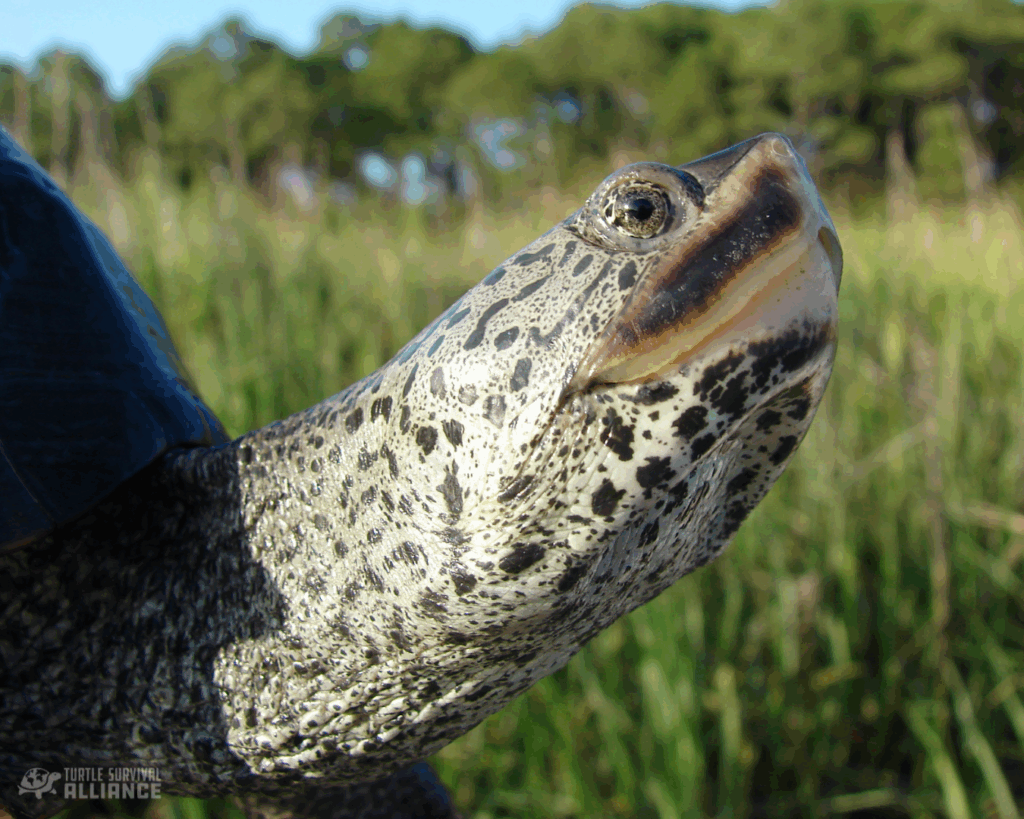
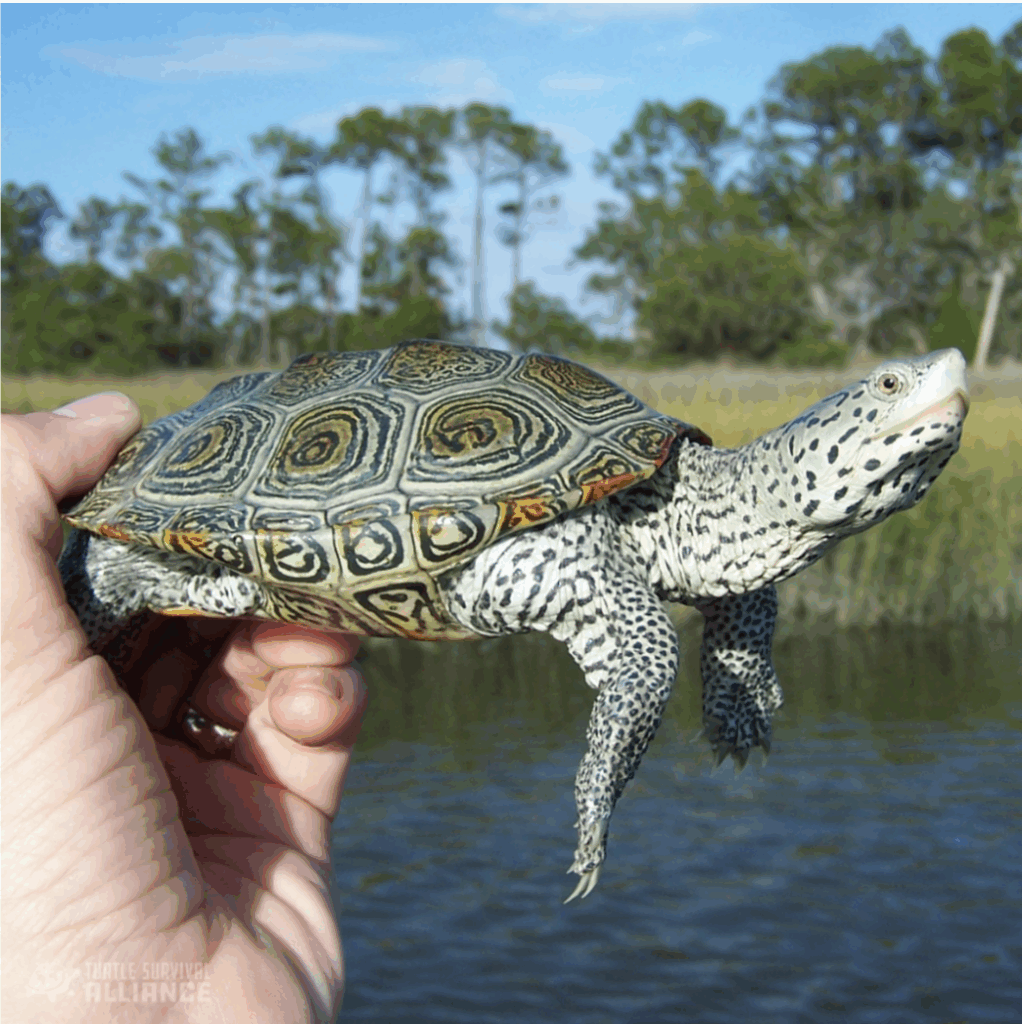
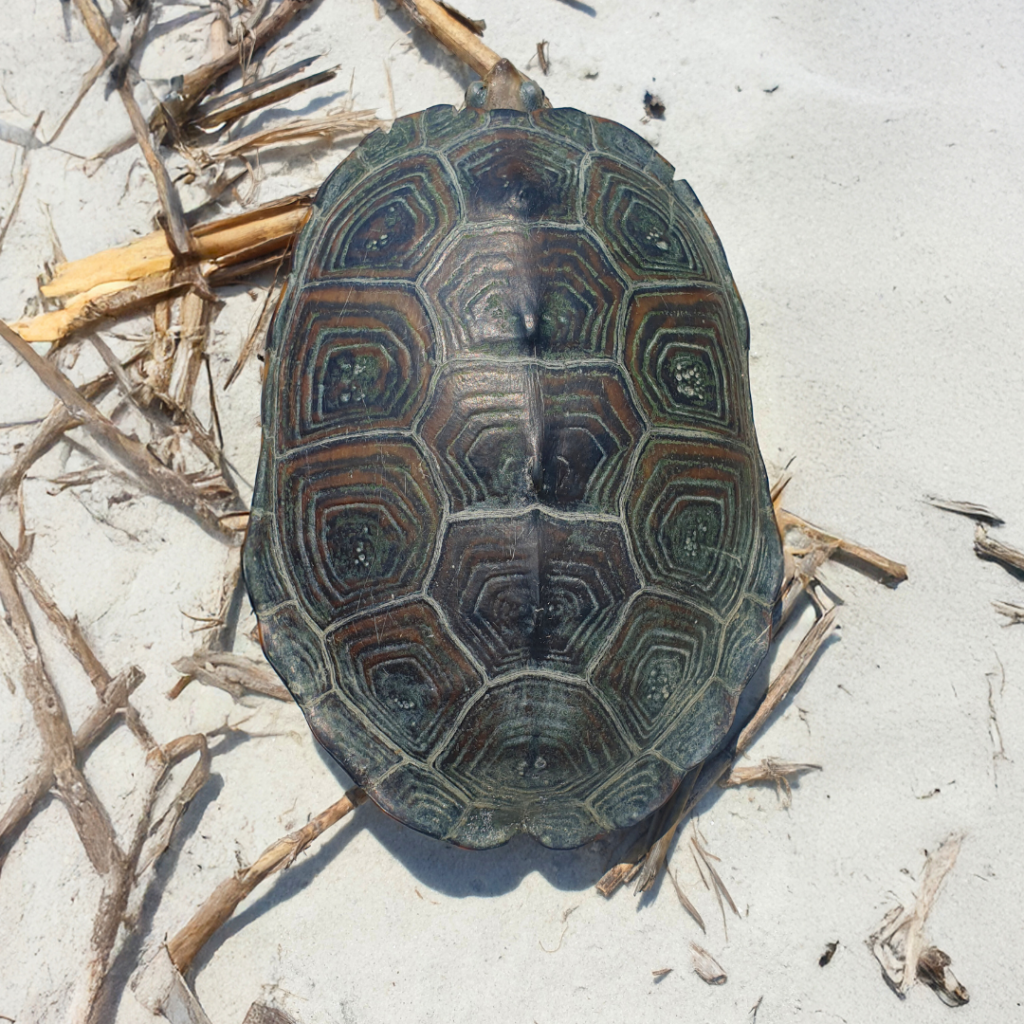
Diamondback Terrapins (Malaclemys terrapin) are distinguished by their pale, grayish-white skin with flecks of black and distinct beak. The name “Diamondback” was given to this species due to the diamond-like appearance of the scutes on their shells. Subspecies and individuals within a subspecies vary widely in appearance, both in color and pattern.
This gorgeous species is sadly one of hundreds that face extinction due to habitat destruction, climate change, predation, and overcollection, among other human-driven threats. Thankfully, it’s also one of the 150+ species that Turtle Survival Alliance positively impacts through conservation efforts.
We support Team Terrapin in northern Florida to conserve this vulnerable species. In partnership with Florida State Parks, Jacksonville University, and Jacksonville Zoo and Botanical Gardens, Team Terrapin conducts daily research surveys every year from April to September to gather invaluable data that help assess the threats the species faces.
I was fortunate enough to attend just a few of these surveys this spring to get a firsthand look at the work that goes into protecting this gorgeous turtle, which many members of Team Terrapin commonly refer to as “DBTs”. Team Terrapin has built a longstanding relationship with Florida State Parks to conduct permitted surveys along a small portion of the species’ range where DBTs are known to nest. Every spring, female DBTs leave their brackish-water habitat to traverse the beach, searching for a safe place to nest. This journey can be perilous. Predation from raccoons, dogs, coyotes, and obstacles in the form of litter, beach-goers, and fishermen all pose dangers to the female as she leaves the safety of her watery home to bury her eggs, hoping they don’t succumb to these and other threats.
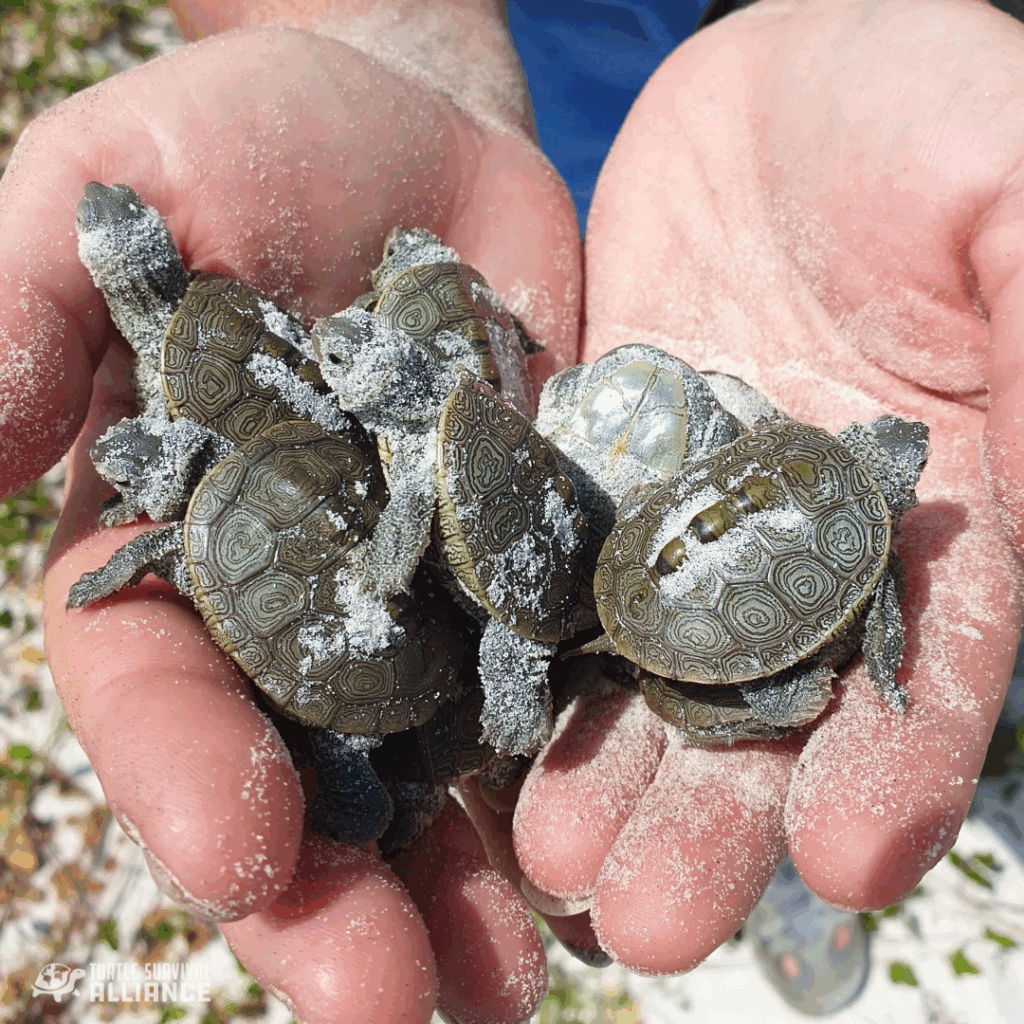
Team Terrapin was founded in 2016 to monitor nesting female Diamondback Terrapins and their nests & hatchlings. Photo by Tabitha Hootman
Team Terrapin’s role is to patrol these beaches early in the morning, every single day of the six-month period covering both nesting and hatching. And, as I would soon learn, these daily trips to the coast are anything but a walk on the beach. I first went out with Team Terrapin Project Leader, Tabitha “Tabby” Hootman, on an early May morning around 6 a.m., alongside one of the 90+ volunteers who also dedicate half of their year to these surveys. We packed about 50 pounds of gear—including two-foot-long calipers, scales, clipboards of data sheets, GPS units, and 64 oz of water—into the waterproof bag on the canoe.
Once we arrived at the site, we tied up the canoe and hid our oars to avoid opportunistic thieves, then hauled the gear with us. We trekked about a quarter mile to the nesting site, wading through pluff mud, and weaving through briar, cacti, ghost crab holes and fire ant hills. By the time we got to the nesting site, it was nearly 7 a.m., but the sun was already beating down upon us. The coolest day I experienced over my several outings this spring was a balmy 80 degrees, with a humidity of 70%. According to Tabby, in July they’re lucky to experience anything cooler than 90 degrees.
Once we made it to the nesting beach, we slowly meandered along the shore, looking for nearly indiscernible tracks of females that had come up to nest—or had returned to the estuary after nesting. Tabby is a natural. After decades working with DBTs, she can spot the tracks yards away. They’re so subtle that anyone else would walk over them without a second thought.
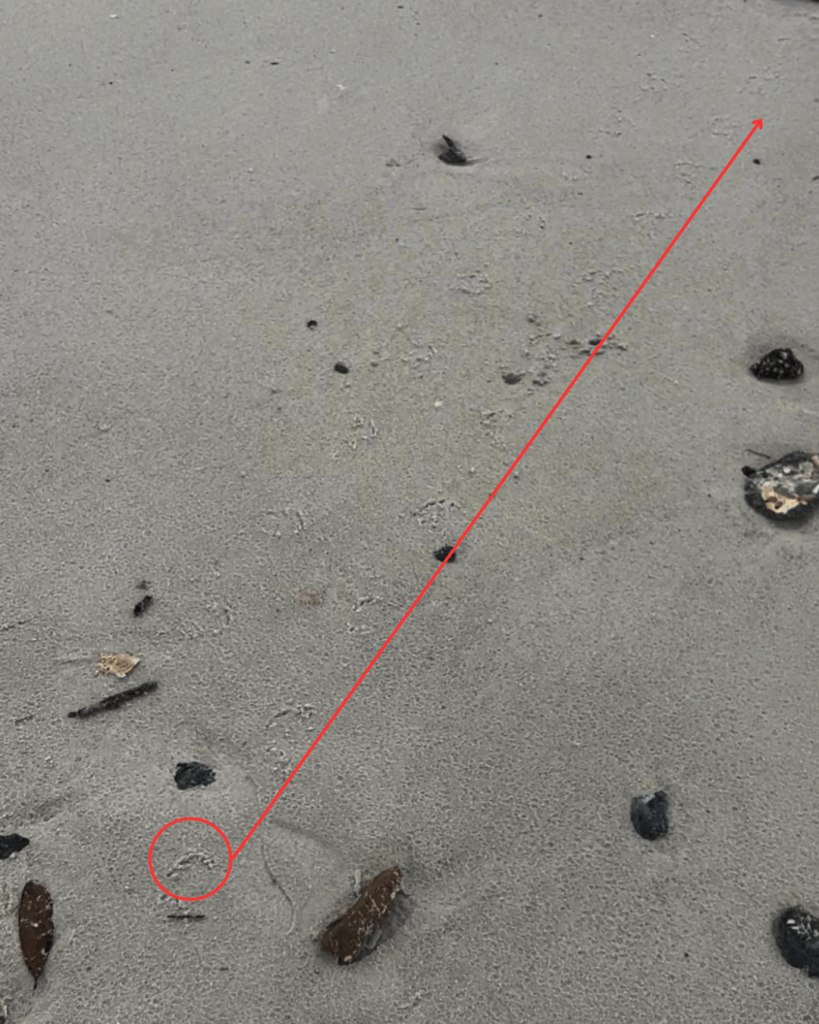
Once we find the tracks, we can tell if a female has already nested or not depending on the shape of them. If they are headed toward the beach but none to show she has gone back down, then she’s likely still nesting or hiding in the brush nearby. If there are two sets of tracks, we know that she has returned to the water, and we will likely find the eggs.
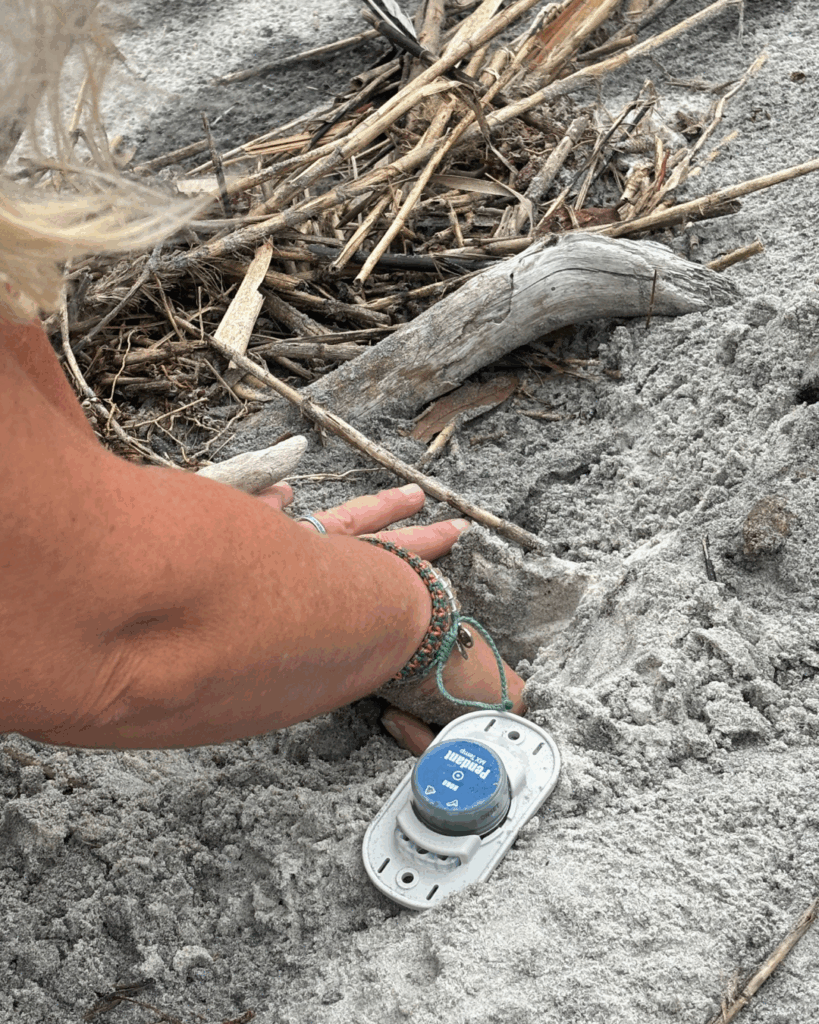
After a nest is located, digging down to the eggs is as delicate as a game of Operation. The goal is to feel around in the sand as gently as possible for the pocket where her eggs are buried without poking them or damaging the nest. On my first trip joining the team, we found just one nest. Tabby used her expertise and instinct to gently feel around a small area where the tracks just barely led to and away from. Once we felt the eggs, we placed a HOBO data logger next to the nest to read the temperature throughout the incubation period. DBTs exhibit temperature-dependent sex determination (TSD), meaning the temperature at which the eggs are incubated determines the sex of the hatchling. The mnemonic for remembering which temperature produces which sex for this species is “hot chicks, cool dudes”, meaning higher temperatures yield more females and lower temperatures yield more males. And, northern Florida has only gotten hotter since this survey effort began more than twenty years ago, which could indicate that females outnumber the males.
Finding a nest is always a win, but the best part of a survey is finding a live turtle. On my third trip out, I was lucky enough to find one. As we patrolled a section of the beach, Tabby pointed out a distinct line of tracts that were much more visible than what we usually see. These tracks actually showed two sets of up-tracks, and no down-tracks. That meant that two females had gone up to nest and were likely still on the beach, waiting for a window to return to the water. It was now a waiting game. We sat baking in the sun (there is no shade on these beaches), waiting for the slightest movement. After 30 minutes, I saw what looked like a football-sized lump start to emerge from behind a rock. Sure enough, it was a female that had just laid her eggs. We began to process her: weighing her, measuring her carapace and plastron, and noting any unique physical features. This turtle had a large, healed-over gash on her shell, likely from a boat propeller slicing her years ago.
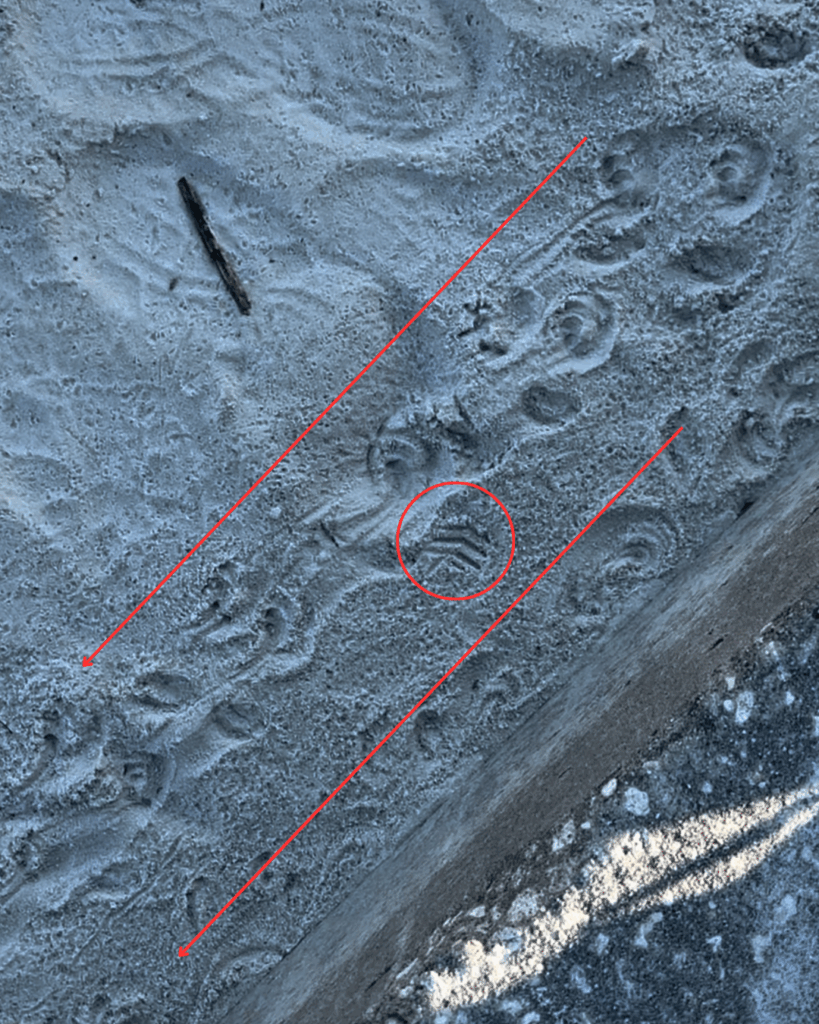
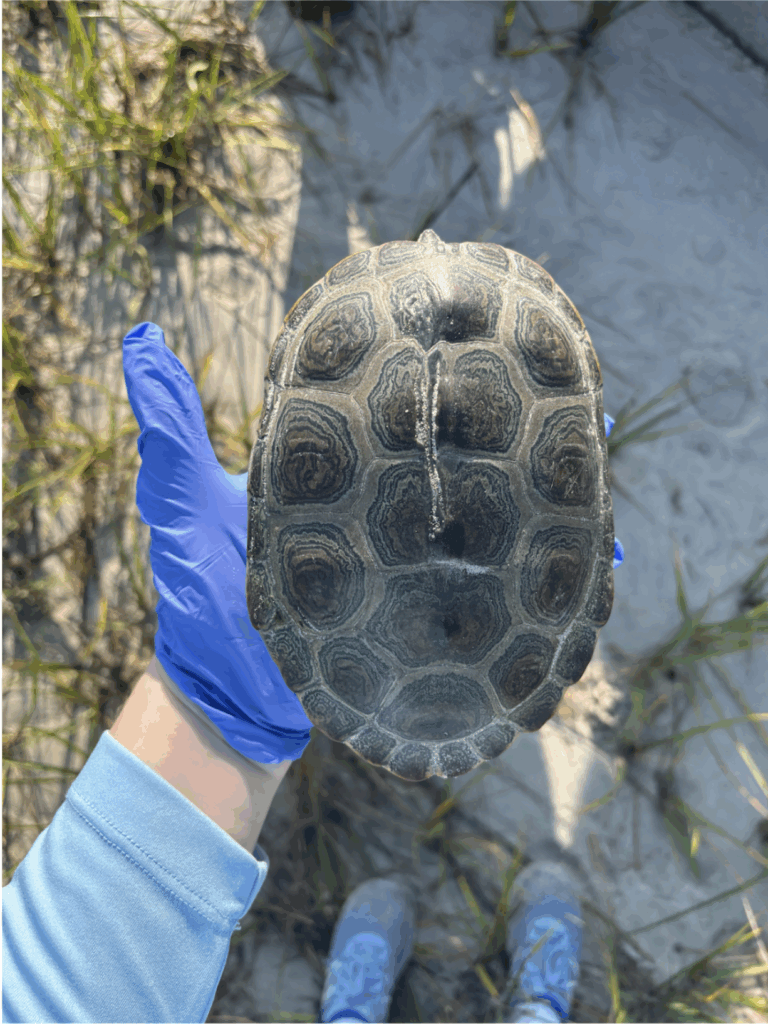
(Left) The tracks on the beach indicate that two turtles went up the shore to nest, but had not yet returned to the water. The circled mark shows how their claws and webbed feet leave indentations in the sand. (Right) This female Diamondback Terrapin has a large, healed-over gash on her shell, likely due to a boat propeller slicing her years earlier. Photos by Elena Duran
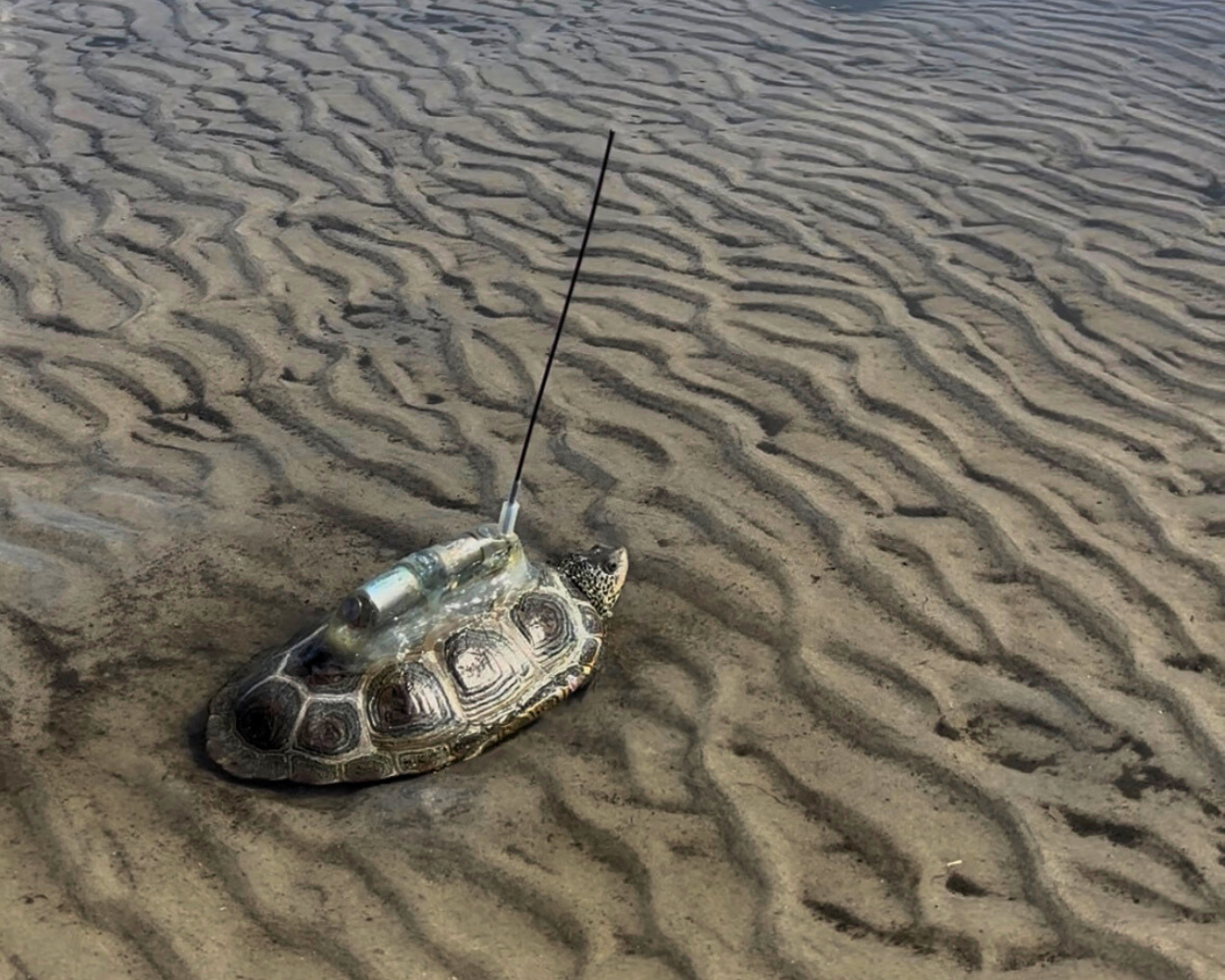
After taking the necessary data, we moved on to a new step for this effort: a project begun this summer in collaboration with the United States Geological Survey (USGS). We had to add a tracking device to the top of the turtle’s shell. This project aims to track DBTs using satellite telemetry to reveal their movement and interaction patterns in the habitat, and how they are affected by man-made threats.
After attaching the device, we sent the female on her way. We then found her nest, added the HOBO, and staked a flag to mark it and signal to any beach visitors to avoid the area. By this time, it was only 10 a.m. We still had to hike back to the canoe, paddle against the tide to the dock, unpack, and finish recording the data. Despite these challenges, I found this experience to be one of the most engaging surveys that I’ve been a part of. Tabby and the Team Terrapin volunteers are so committed to this work, enduring early hours, insanely high heat and humidity, and hostile terrain, all for the slim chance that they will see a DBT starting the next generation of her species.
A female Diamondback Terrapin affixed with a tracking device is released back into her estuary home. Video by Elena Duran
Few others in Northeast Florida are working with this species. Without the research efforts of Team Terrapin, the Diamondback Terrapins here would go understudied, have fewer chances to succeed with reproduction, and could silently disappear, without us ever knowing how we could have stopped their decline. What stood out on my trips, besides the dedication of the team, was how invasive mankind’s infrastructure is on the turtles’ remaining critical habitats. I can’t give the exact location of them in order to protect the turtles from being targeted, but I can mention how close they are to highways, to bridges, to fishermen, and to party boats. One female’s nest was buried just feet from the crumbling concrete of an old road that was built into her habitat, only to be abandoned later. As we surveyed the beaches, liquor bottles, garbage, and other litter cluttered the shore, blocking paths that females would take to reach their nesting sites. Tabby also told me that the beaches we survey used to extend much farther into the estuary, but erosion, dredging projects, and development have shrunk the remaining habitats to slivers of shore.
We can’t reverse the damage that’s already been done to this iconic coastal turtle, its habitats, and the many of other species that depend on them, but what we can do is to continue supporting the conservation efforts of Team Terrapin, whose efforts can help guide positive management decisions and policymaking. Our work with USGS may provide compelling evidence toward the requirement of exclusion devices on crab traps, preventing unnecessary DBT drownings. By working with Florida State Parks, we protect the remaining slivers of shoreline that house the fragile habitats that the turtles need.
Team Terrapin are some of the only people that are protecting the Diamondback Terrapin in northeast Florida. My few days surveying with Tabby and the volunteers gave me just a glimpse of the work they do every day for six months of the year to protect these magical-looking creatures. I hope that the next time you imagine a turtle, you think of the Diamondback Terrapin—not just because of its charming mustache and dazzling shell, but because it needs your help alongside hundreds of other species.
If you want to make an impact, you have already just by taking a few minutes to read my blog. To help even more, you can follow us on our social platforms, subscribe to our newsletter, make a donation, and incorporate eco-friendly practices into your life. You can watch our webinar, Terrapin Tracks: Conservation in Action in Northeast Florida, to learn more about Team Terrapin’s work.
As you can see, turtle conservation is no walk on the beach, and we could use all the support possible to make a difference.
Thanks for reading,
Elena
–
Make an Impact:
Donate Directly to Team Terrapin
Donate to Turtle Survival Alliance
Follow us: