
25 Year Celebration of the Ideology of Turtle Survival Alliance
At the turn of the 21st century, turtles were disappearing at a rate few people fully understood. Tortoises that descended from forests into fruit tree plantations were collected en masse. Trotlines spread across rivers ensnared turtles drifting with the current. Nets staked in wetlands corralled turtles for capture. Turtles living in cool, clear mountain streams were easily plucked from pools until there were no more.
Meanwhile, from Kolkata to Jakarta to Hong Kong to Guangzhou, markets filled with them. Millions of them. Processing centers held small mountains of live turtles. Metal cages, tubs, burlap sacks, and glass aquariums in markets were filled to the brim with species once thought common and others not yet described by science. In some places, the animals were openly slaughtered for specific cuts of meat or organs.
The need to satiate overwhelming demand for food, traditional medicine, and, increasingly, pets became an epidemic. By the turn of the 21st century, conservationists around the world were witnessing the devastating effects of what became known as the “Asian Turtle Crisis,” leaving vast regions of South and Southeast Asia nearly void of turtles.
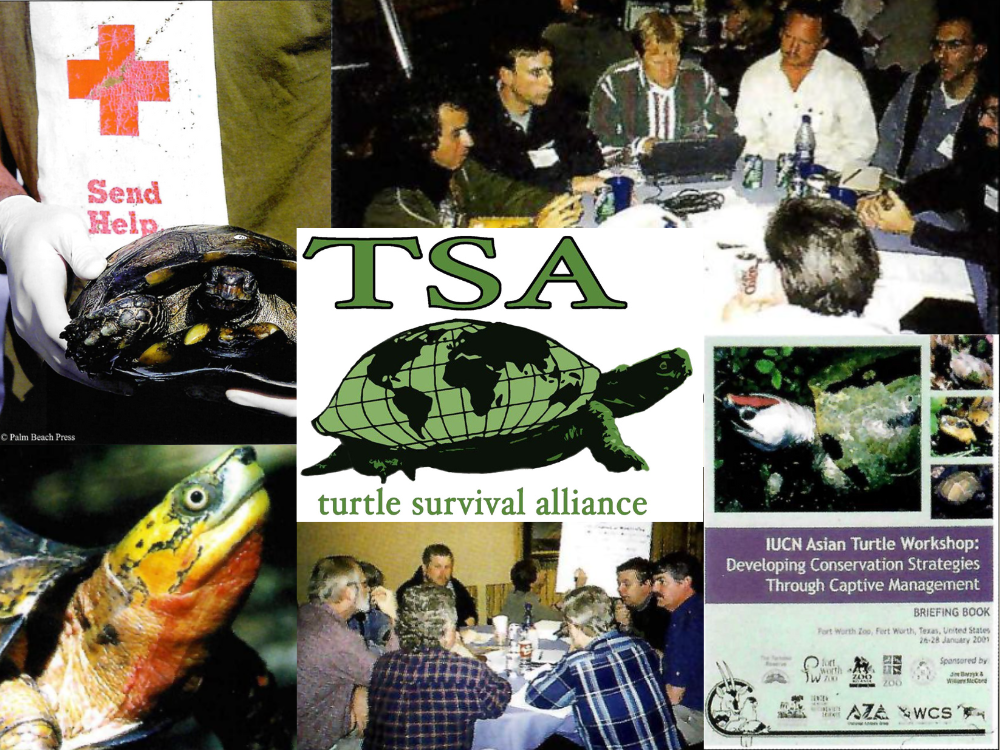
Twenty-five years ago today, on January 26, 2001, more than eighty individuals gathered at the Fort Worth Zoo in Texas to confront that crisis. The three-day meeting, titled Developing Conservation Strategies Through Captive Management, brought together representatives from NGOs, zoos and aquariums, specialist groups, commercial and private breeders, conservation organizations, veterinary practitioners, universities, corporations, government and regulatory agencies, and field biologists.
What unfolded was, at times, a contentious exchange of ideas shared by diverse personalities, backgrounds, and viewpoints. But out of that complexity, a shared purpose emerged: to save turtle species from extinction.
“The January 2001 Fort Worth meeting brought together a very diverse group of people involved economically, concerned about conservation, or in love with turtles. As you can imagine, getting that diverse group all to acknowledge a turtle crisis and then agree to work together was an exceptional feat. This meeting was an excellent collaboration and an event that I believe cemented the existence and need for the Turtle Survival Alliance.” – Kurt Buhlmann, Senior Research Associate, University of Georgia’s Savannah River Ecology Laboratory
“As the meeting progressed, it became obvious to me and others that what we needed was not just discourse and workshop collaboration between all the constituencies, but the creation of a new organization with all of us working together under one umbrella to move forward with our goal of protecting turtles and preventing their extinction. – Dr. Anders Rhodin, Board Member, Turtle Survival Alliance, Emeritus Chair and Executive Vice Chair, IUCN SSC Tortoise and Freshwater Turtle Specialist Group
In spite of the many hurdles that could have derailed this initial meeting of minds in Fort Worth, a task force of the IUCN SSC Tortoise and Freshwater Turtle Specialist Group was formed as the Chelonian Captive Survival Alliance, or CCSA, complete with a Steering Committee. This group would soon become what we now know as the Turtle Survival Alliance. Less than two months later, the Steering Committee convened its first meeting in Chattanooga, Tennessee, setting out to define goals and objectives, roles and responsibilities, resources and funding, and to identify key stakeholders.
“It’s always a challenge to bring people together to make plans for what everyone agrees on. I believe that the processes that we had in place at the meeting brought out the best in people. This discussion opened up new horizons for turtles, along with the realization that we were all stronger together than working in silos.” – Dr. Susie Ellis, Executive Director, International Rhino Foundation, former Board Member, Turtle Survival Alliance
“Thinking back to that meeting, I recall being impressed by how so many people had become aware of how serious the survival prospects of many Asian tortoises and freshwater turtle species were. That awareness helped shape Turtle Survival Alliance’s efforts and partnerships toward in-country work, building species and country programs that have seen spectacular success in some places, while in others still needing to scale up to meet what’s needed.” – Peter Paul van Dijk, IUCN SSC Tortoise and Freshwater Turtle Specialist Group Executive Committee
The original mission was to develop and maintain an inclusive, broad-based global network of living collections of tortoises and freshwater turtles, with the primary goal of maintaining chelonian species over the long term to maximize future options for the recovery of wild populations. Yet it became clear that captive breeding alone could not fully address the scale of the challenge. Habitat protection and in situ conservation needed to be central, not peripheral, to the mission.
“Despite the initial widely divergent and often contentious perspectives among the participants, the group gelled around our common mission to save not just Asian turtle species from extinction, but all turtles. And so the seeds of the Turtle Survival Alliance were sewn.” – Dr. John Iverson, Biology Research Professor, Earlham College, Board Member, Turtle Survival Alliance
“After years of frustration over the Asian Turtle Crisis, the turtle conservation community finally had a grassroots organization to rally behind. We realized early on that we needed to harness that energy and not lose momentum. Fortunately, we had strong support from some prominent zoos and conservation organizations that sustained TSA through those early years. Though our initial focus was captive breeding programs for Asian turtles, we soon expanded, recognizing the essential role that range country partners and field conservation played in preventing extinctions. While we never lost sight of the importance of captive programs, efforts to save species in the wild alongside assurance colonies became the foundations on which Turtle Survival Alliance continues to build.” – Rick Hudson, President Emeritus; Turtle Survival Alliance
Twenty-five years later, what began as a response to near-empty rivers, depleted wetlands and forests, and vanishing species has become the world’s largest and most comprehensive turtle and tortoise conservation organization, working across more than 30 countries to prevent extinction. We acknowledge and honor those who laid this foundation, whose vision, courage, and dedication made everything that followed possible.
“As we look to the next 25 years, our resolve is stronger than ever. We are empowered by the tangible successes of the past quarter century, including bringing the Burmese Star Tortoise back from the brink of extinction, establishing the world-class Turtle Survival Center as a global hub for assurance colonies, advancing genetics-based conservation decision-making, and championing conservation action for more than 115 threatened turtle species. The challenges remain urgent, and we continue to grow and strengthen our capacity to meet them through partnerships, innovation, and a global community that refuses to give up. The Turtle Survival Alliance was built on hope and sweat equity, and this foundation of resilience will carry us forward until recovery replaces rescue. The next chapter begins now.” – Dr. Marc Dupuis-Desormeaux, President & CEO, Turtle Survival Alliance
Header image: various photos from the 2001 Turtle Survival magazine and the 2002 Turtle Survival magazine, including the original meeting, target species, and the cover of the workshop briefing book.